
The year 2026 has arrived, and the collective boardroom promise of Artificial Intelligence is under scrutiny. For the past three years, enterprises have been in a frenzy—treating AI like a “Gold Rush,” rushing to purchase every isolated tool that promised to “revolutionize” their workflow. The result? As we audit the mid-year balance sheets of 2026, a stark reality emerges: Most organizations have a chaotic assembly of tools, but no scalable capability.
We are currently operating in a state of “Digital Fragility.” They have pockets of intelligence, but silos of messy data, confused employees, and an infrastructure that is more a “House of Cards” than a “Powerhouse.” To move from this fragile state to a robust, ROI-generating asset, we must pivot our entire perspective.
1. Shift from the “Plug-and-Play” Dream to Strategic Architecture
The fundamental misconception in the C-suite is that AI is a software purchase. It is not. AI is a Strategic Capability.
Imagine trying to install a turbocharger into a horse-drawn carriage. The engine might be powerful, but the chassis will disintegrate. This is the “broken workflow” problem that AI adoption faces. If your underlying business processes are outdated, fragmented, or manual, plugging in a high-performance AI model only accelerates your failure. It doesn’t fix the process; it just automates the chaos.

2. Data Governance: The Invisible Guardrails of Information Integrity
You cannot build a scalable ecosystem on quicksand. In the context of AI, “quicksand” is ungoverned data. As we scale our AI operations, the stakes of data integrity have never been higher
While Data Governance might sound like a technical, backseat function, in 2026, it is your Maximum Competitive Advantage. It is the invisible force that prevents your enterprise intelligence from becoming misinformation. Why is this critical right now?
Information Integrity: In a world saturated with synthetic content, how do you know your AI model is learning from the absolute “Source of Truth”? Governance provides the verification layer.
Ethical Compliance: The regulatory landscape of 2026 is exponentially more complex than in 2023. Strict privacy laws are active global mandates. Without governance, your AI adoption is an unethical liability, exposing your brand to massive penalties and reputational collapse.
Scalable Data Lineage: You must have granular knowledge of where your data originates, who has accessed it, and how it has been modified. This isn’t just about safety; it’s about traceability—the ability to audit your AI’s “decisions.”
A well-governed data infrastructure is not restrictive; it is empowering. It gives your AI the confidence to act.
3. The New Analogy: AI Adoption is Like Building a Skycraper

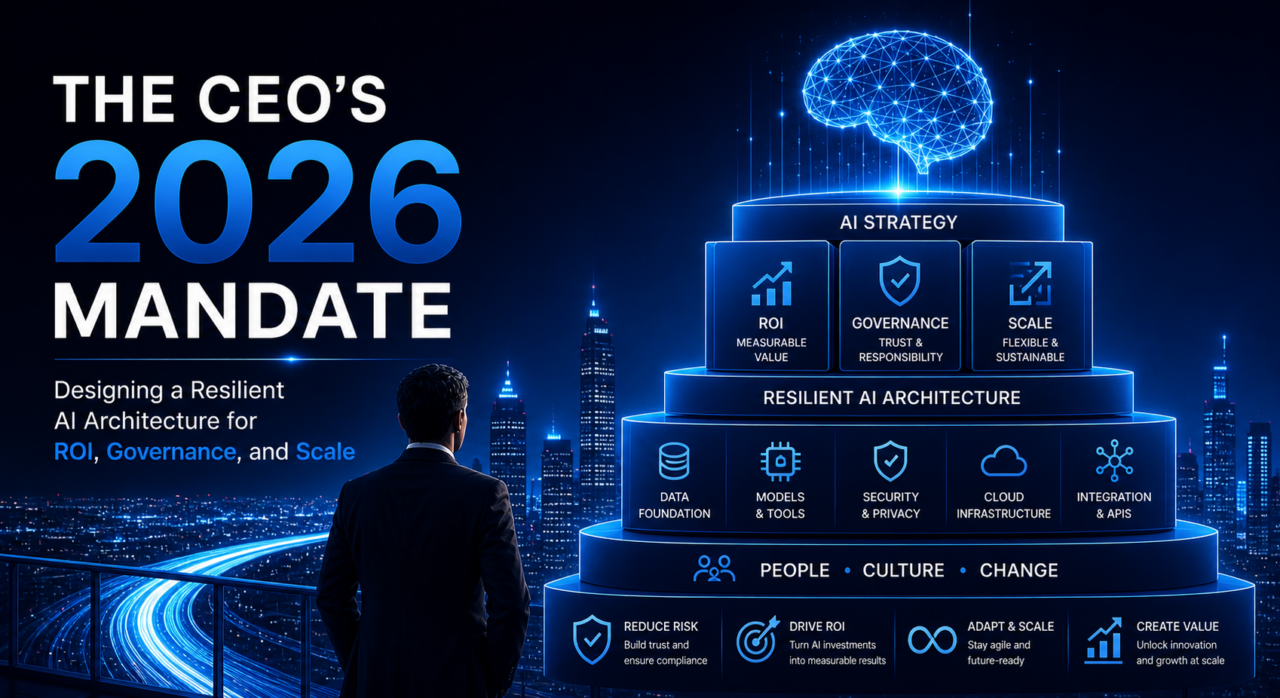
Let us discard outdated analogies and adopt a concept relevant to scaling: Modern Architecture. Imagine you are building a 100-story skyscraper in the heart of a city. This building represents your Scalable AI Ecosystem.
- The Foundation is Governance
Before you can lay the first floor, you must dig deep into the ground. A monumental foundation of steel piles, reinforced concrete, and deep pillars is laid. The deeper and stronger the foundation, the higher the building can go. In your company, this deep foundation is Data Governance. The stricter and more comprehensive your governance framework, the more intelligent and scalable your AI can be. If you skimp on the foundation (skimp on governance), the entire building will become unstable as soon as you add complexity (Scale).
- The Core Structure is Architecture
Rising from the foundation is the building’s main core—the skeletal structure of beams, columns, and floors. These aren’t just random parts; they are precisely designed to bear the load and support the structure as it grows. This designed core is your AI Architecture. It is the blueprint that ensures your CRM, your operational data, and your financial data talk to each other in a unified language.
- The Offices are the Applications
Only after the main core is secure do we fill the individual floors with offices, residential units, or retail spaces. These are the Isolated AI Applications—the specific chatbot, the predictive modeling tool, or the automated reporting tool. If you have a solid foundation (governance) and a cohesive core structure (architecture), you can easily add, change, or upgrade these office spaces (applications) without destabilizing the building.
- The Elevators are the Implementation
Finally, how do you navigate this monumental structure? You need a complex system of efficient elevators and staircases that connect the bottom floor to the top floor. This seamless movement of information—bringing data from the governed foundation directly to the application layer—is your Implementation Flow. Implementation is not about installing a tool; it is about connecting your infrastructure

4. Phoenix 4Service Suite: Architecture for the Future
The current state of enterprise AI is fragmented. Different departments are running isolated tools that do not talk to each other. It is an unsustainable model that leads to high costs and low utility.
The Phoenix 4Service Suite was engineered to solve this “Fragmentation Crisis.” It is not just another application in your stack; it is the Unified Data and Governance Layer that bridges the gap between your governed data foundation and your scalable application structure.
Unified Data Layer: The Phoenix Suite integrates your operational, customer, and f inancial data into a cohesive, standardized environment. This ensures that when your AI models make decisions, they are acting on the full, governed story—not just an isolated chapter.
Governance-by-Design: With evolving regulations, compliance cannot be an afterthought. The Phoenix Suite has automated compliance and privacy controls “baked into” the workflow. Every interaction handled by the suite is tracked, secured, and validated against your corporate governance policies.
Strategic ROI Oversight: Moving beyond vanity metrics, the Phoenix Suite provides CEOs with a “Strategic Control Tower.” You get real-time, outcome-based analytics that show how AI is actually optimizing operational efficiency or revenue, allowing for immediate strategic shifts.
5. Moving Toward an Integrated Future
The differentiator for successful companies in the latter half of 2026 will be their ability to move beyond disjointed automation and toward a unified, Resilient Architecture.
A resilient architecture means having a dynamic roadmap that stays anchored in core business goals while remaining adaptive to new technologies. It means building a sustainable ecosystem that allows you to add complexity as your business scales, without risking collapse.
Conclusion:
AI roadmap planning is not a technical requirement; it is a leadership mandate. The era of buying “disposable tools” is over. By implementing the Phoenix 4Service Suite, you are investing in Sustainable Infrastructure. You are choosing a path that prioritizes integrity in your data foundation, elegance in your core architecture, and excellence in your strategic execution.
Do not react to the crisis of fragmentation; proactively design your future.
Stop buying tools. Start building outcomes.